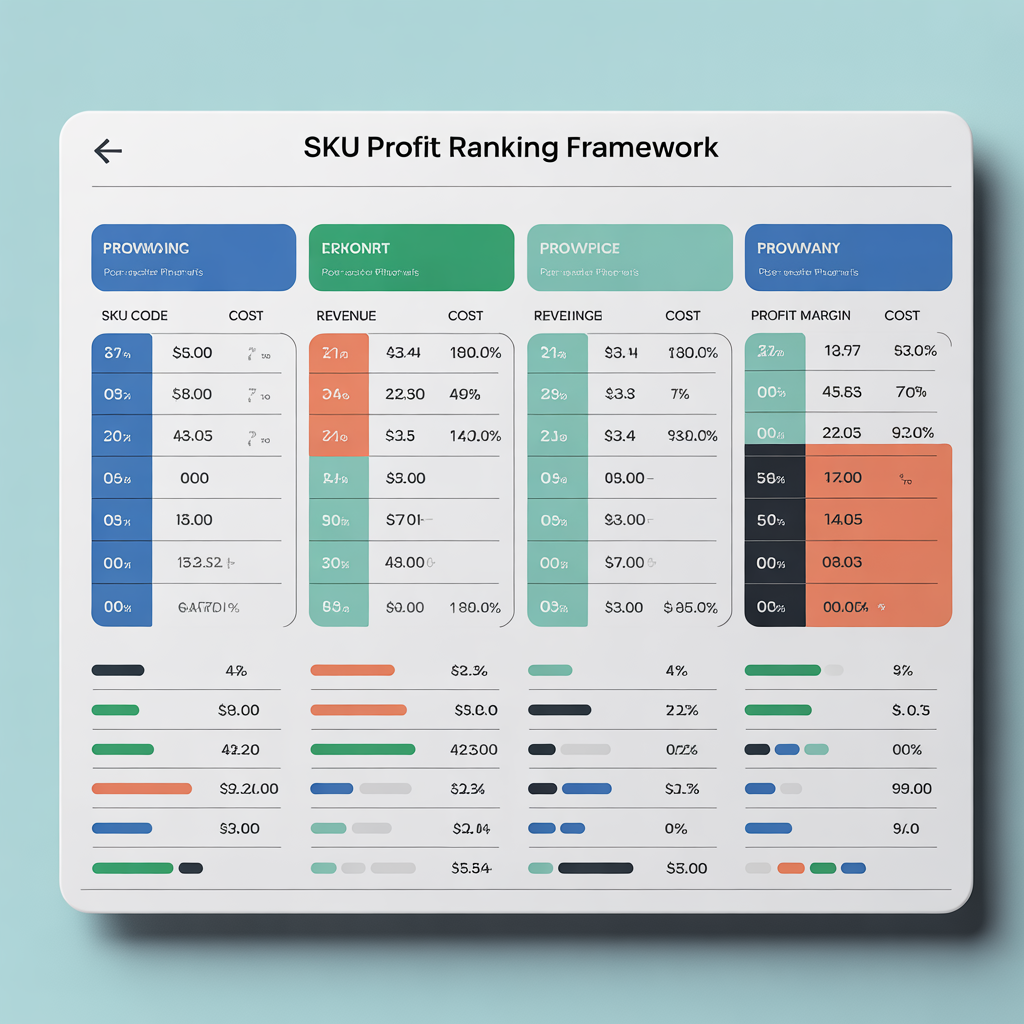
The SKU Profit Ranking Framework
Identify Your Real Money-Makers—and Eliminate the Products Quietly Killing Your Profit
Overview
Not all bestsellers are profitable—and not all low-volume products are weak.
This framework helps you rank every SKU by true profit contribution, so you can stop being misled by revenue and start scaling what actually makes you money.
SECTION 1: The Core Principle — Revenue Lies, Profit Reveals
Most retailers focus on:
👉 “What sells the most?”
Elite operators focus on:
👉 “What makes the most profit?”
Key Insight:
A high-revenue product with low margin can be LESS valuable than a lower-selling product with high margin.
SECTION 2: The SKU Profit Formula
This is the foundation of the framework.
Profit Per SKU:
Total Profit = (Selling Price – Cost) × Units Sold
Example:
- SKU A:
- Price = $100
- Cost = $70
- Units Sold = 200
👉 Profit = $6,000
- SKU B:
- Price = $60
- Cost = $20
- Units Sold = 120
👉 Profit = $4,800
👉 SKU A sells more—but SKU B may still be more efficient depending on strategy.
SECTION 3: The SKU Ranking System (4-Tier Framework)
Tier 1: Profit Champions (Scale Aggressively)
- High sales + high margin
- Strong demand + strong profit
👉 Actions:
- Increase inventory
- Raise prices slightly
- Feature prominently
Tier 2: Volume Drivers (Optimize Carefully)
- High sales + low margin
👉 Actions:
- Improve pricing
- Reduce costs
- Bundle to increase profit
Tier 3: Margin Builders (Promote More)
- Low sales + high margin
👉 Actions:
- Increase visibility
- Train staff to sell
- Reposition product
Tier 4: Profit Killers (Fix or Remove)
- Low sales + low margin
👉 Actions:
- Mark down or bundle
- Stop reordering
- Eliminate if needed
SECTION 4: Fill-in-the-Blank SKU Ranking Template
Per SKU:
- Product Name: __________
- Selling Price: $__________
- Cost: $__________
- Units Sold: __________
👉 Profit Per Unit = $__________
👉 Total Profit = $__________
Classification:
- Tier 1 / Tier 2 / Tier 3 / Tier 4
👉 Repeat for top 20–50 SKUs.
SECTION 5: The Profit vs Revenue Matrix
Plot your products like this:
| High Margin | Low Margin | |
| High Sales | Champions | Volume Drivers |
| Low Sales | Margin Builders | Profit Killers |
👉 This visual instantly reveals priorities.
SECTION 6: The 80/20 Profit Rule
👉 80% of your profit comes from 20% of your SKUs
Action Plan:
- Identify top 20% profit generators
- Allocate more inventory + marketing
- Reduce focus on low performers
👉 Scale what works—cut what doesn’t
SECTION 7: Hidden Profit Leak Detection
Watch for these traps:
“Fake Bestsellers”
- High revenue
- Low margin
👉 Look successful—but drain profit
“Invisible Winners”
- Low volume
- High margin
👉 Often ignored—but highly valuable
“Dead Weight”
- Low sales
- Low margin
👉 Pure inefficiency
SECTION 8: Weekly SKU Optimization Routine
Step 1: Rank Top SKUs by Profit
👉 Not revenue
Step 2: Identify Tier Distribution
- How many in each category?
Step 3: Take Action:
- Scale Tier 1
- Optimize Tier 2
- Promote Tier 3
- Eliminate Tier 4
👉 Repeat weekly or monthly
SECTION 9: Advanced Insight — Profit Density
Elite retailers track:
👉 Profit per square foot / shelf space
Question:
- Which products generate the most profit per space?
👉 Prioritize those in premium locations
SECTION 10: Your SKU Profit Action Plan
Step 1: Identify Top 10 Profit SKUs
👉 __________
Step 2: Identify Bottom 10 SKUs
👉 __________
Step 3: Take Immediate Action
- Scale winners
- Fix or remove losers
👉 Speed creates advantage
Usage Tips / Advanced Applications
- Run monthly for strategic clarity
- Apply per category for deeper insights
- Combine with inventory velocity tracking
- Use before large buying decisions
Wrap-Up
The biggest mistake in retail is chasing revenue instead of profit.
This framework gives you a clear, structured way to identify what’s actually driving your business—and what’s silently holding it back.
Use this asset to instantly shortcut bad product decisions, focus on what truly matters, and operate like a profit-driven retail strategist.